
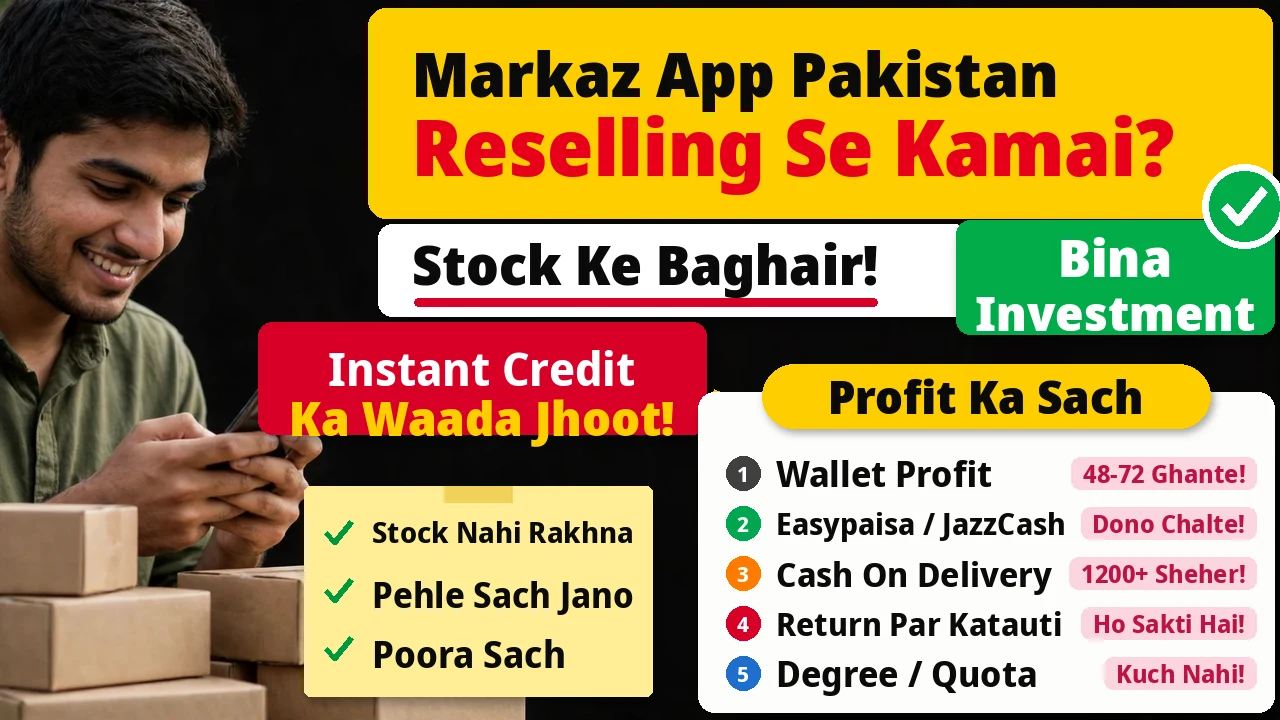
If you have searched for Markaz app Pakistan, you have probably seen the same promise everywhere: earn up to Rs 45,000 a month from your phone, with no investment. Some of that promise is real — Markaz genuinely lets you sell products you never buy, never store and never deliver yourself. Some of it is marketing dressed as a fact. This guide separates the two: how reselling on Markaz actually works, step by step, how and when your profit reaches you, and the catches that the promotional posts leave out.
Short version first: you pick products from the Markaz catalogue, share them with your own contacts on WhatsApp, Facebook or Instagram, add your profit on top of the wholesale price, and place the order to your customer’s address when someone wants to buy. Markaz handles delivery and collects cash on delivery. Your profit is then transferred to your Easypaisa or JazzCash account — Markaz’s own blog says within 48 to 72 hours of a delivered order. You never buy stock in advance. That “never buy stock” part is the whole business model, and it is also why your income depends entirely on whether people actually buy what you share.
What Markaz Is, in One Paragraph
Markaz is a Pakistani social-commerce app: a wholesale marketplace that sits between suppliers and resellers. You are the reseller. You do not own a shop, you do not hold inventory, and you do not deal with couriers. Markaz sources products, lists them at wholesale prices in the app, delivers them across Pakistan — its own blog says it covers more than 1,200 cities — and collects payment by cash on delivery, which is the payment method most first-time Pakistani buyers actually trust. Your job is the part no app can automate for you: finding customers, presenting products well, answering questions honestly, and following up when a parcel is on its way.
Markaz’s Google Play listing describes the same flow in four steps: browse thousands of products, share them with friends and followers, place the order to their address, and let Markaz handle delivery and COD while you keep your profit. The app is rated 4.0 stars with more than 5 million downloads, which tells you it is widely used — and, as the review pattern below shows, widely argued about. A 4.0 average with tens of thousands of reviews is not a clean bill of health; it is a split verdict, and the split is informative.
Markaz App Pakistan: How to Start Reselling, Step by Step
Step one: install the Markaz app from the Play Store and register with your phone number and a business or shop name. Registration is free, and Markaz says no qualification, degree or certificate is needed — if you have a smartphone, an internet connection and people to sell to, you can start. Attach your Easypaisa or JazzCash account in your profile so profit has somewhere to go; do this before your first sale, not after, because a payout with nowhere to land is a support ticket waiting to happen.
Step two: choose a niche before you share anything. The catalogue covers fashion, bedding, electronics, accessories, beauty and home essentials, and beginners fail by sharing everything to everyone. Pick one lane your contacts already associate with you — kitchen items, men’s fabric, bedding, phone accessories — and learn its prices properly. Compare the wholesale price plus your profit against what the same kind of product sells for in a local market; if your final price is far above the bazaar price, no amount of sharing will fix it.
Step three: set your profit per product before you post it, not after a customer asks. Markaz lets you set your own margin. Its marketing talks about 30% plus profit, but that is an example of what a margin can look like, not a rate the platform pays you. Your profit is simply the difference between the price the customer pays and the wholesale cost Markaz charges — minus whatever deductions apply on returns or cancellations, which is where the honest accounting starts.
Step four: share with context, not just a forwarded picture. A photo with no price, no size or colour information and no delivery note gets ignored or, worse, gets a “yes” from someone who then refuses the parcel when it arrives different from what they imagined. Write the price, the key detail (size, material, colour options), the COD fact and a realistic delivery expectation. Step five: when a customer confirms, place the order to their address in the app, with your profit included. Markaz packs, ships and collects the cash. Step six: track the order in the app and tell the customer when it is out for delivery — the resellers who complain least about returns are usually the ones who communicated most before delivery.
How You Get Paid: The Profit Maths and the Timeline
Here is a worked example, labelled clearly as an example, not a promise. Suppose a product’s wholesale price in the app is Rs 1,000 and you list it to your customer at Rs 1,300. If the order is delivered and paid by COD, your profit on that order is Rs 300 — the Rs 300 difference. Sell ten such orders in a month and your profit is Rs 3,000, before any return or cancellation deductions. Sell none and your profit is zero. There is no salary, no daily wage and no payment for sharing, posting or getting likes. Only delivered, paid orders produce profit, and that single fact explains both the opportunity and the disappointment people report.
Now the timeline, where sources conflict and you deserve to see the conflict. Markaz’s own blog — the more detailed, more careful source — says profit is transferred to your Easypaisa or JazzCash account within 48 to 72 hours of delivery. App-store marketing copy, on the other hand, talks about profit within 24 hours, and at least one listicle claims instant wallet credit on delivery. Treat the 48-to-72-hour window as the working timeline: it is the figure Markaz states in its own explanatory blog post, and it leaves room for the courier and payment reconciliation that a “24 hours” slogan skips. If your profit has not arrived after 72 hours, check the order status in the app first — a returned, refused or still-in-transit order has no profit to pay yet — and only then contact support with the order number.
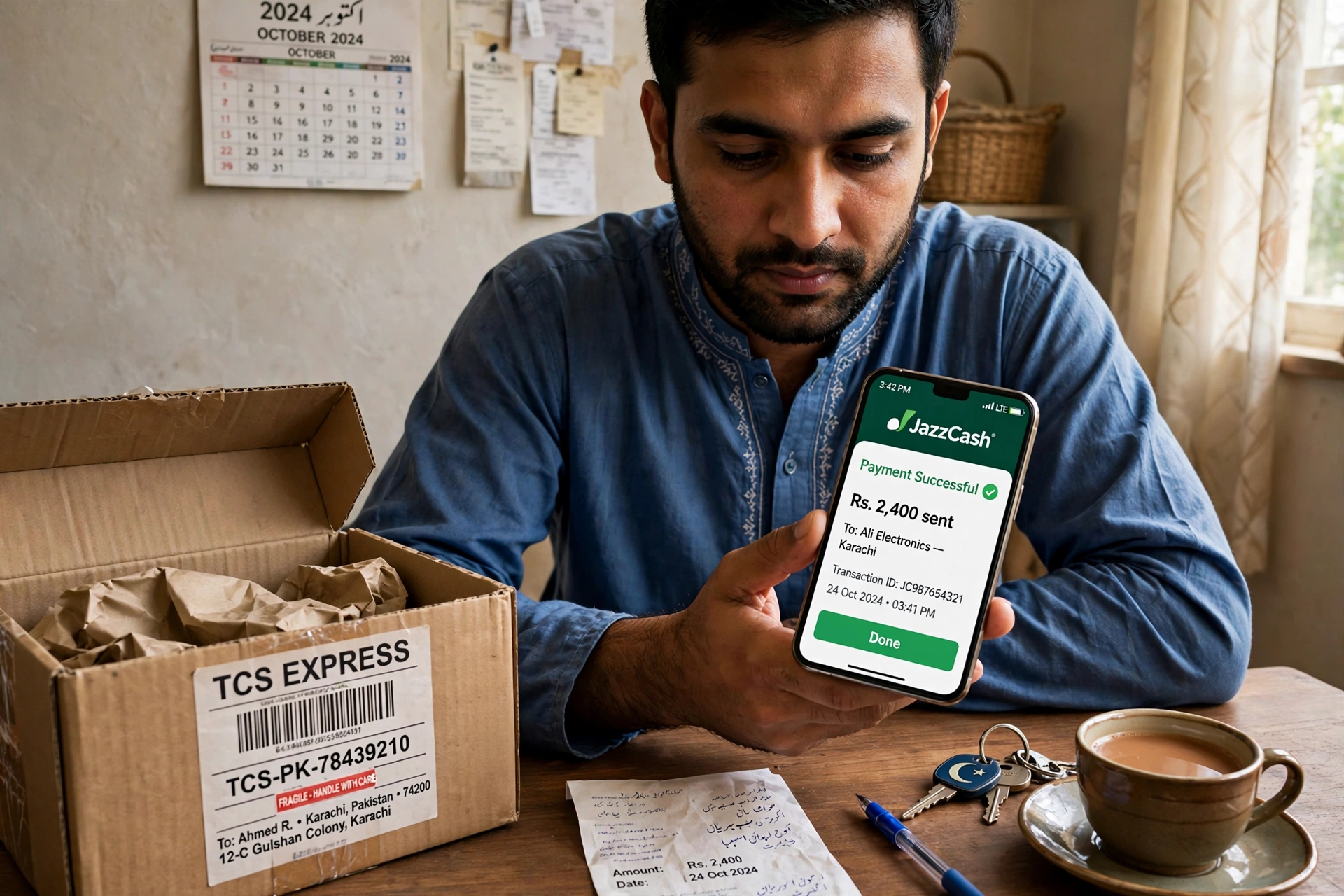
One more accounting point: your payout account must be your own. Markaz’s process sends profit to the Easypaisa or JazzCash account linked to your reseller profile, and using someone else’s wallet invites exactly the kind of verification problem that ends with frozen profit and an unanswerable support ticket. The same own-name rule applies across the earning platforms on this site — see our Payoneer fees guide for the international version of the same lesson.
| Item | What Markaz’s own pages say | What it means for you |
|---|---|---|
| Investment | No stock purchase needed; register with phone number | Zero upfront cost — but also zero income until a sale delivers |
| Delivery | COD across 1,200+ cities; 7-day easy returns | COD builds buyer trust; returns are part of the model, not an exception |
| Profit | You set your own margin on each product | Profit = customer price minus wholesale price, minus return/cancellation deductions |
| Payout route | Easypaisa or JazzCash | Local wallets, no Payoneer or bank needed — link your own account first |
| Payout time | 48–72 hours after delivery (official blog) | Ignore “instant” and “24 hour” marketing claims when planning cash flow |
| Qualification | None — no degree or certificate required | Open to students and beginners; your audience is the real qualification |
The Honest Catches Nobody Puts in the Ad
First, returns eat profit. Markaz offers 7-day easy returns, which helps you sell — but reviewers consistently report deductions for returns and cancellations, extra handling charges, and orders refused at the door after long waits. A refused parcel does not just cancel one sale; it can cost you time, a disappointed customer and, in the reviewers’ accounts, a deduction. Price and describe accurately, confirm the order with the customer before placing it, and never promise a delivery date Markaz has not given you.
Second, delivery is slow by the standard your customers judge it against. Reviewers report waits of seven days or more, couriers refusing inspection before payment, and support replies that do not resolve the problem. Markaz’s own framing — delivery handled end to end — is true in the sense that you do not touch the parcel; it is not a promise of speed. Tell customers upfront to expect several days, and you will keep more of them than if you promise “tomorrow” and deliver next week.
Third, wholesale prices are not always cheap. This is the most common reseller complaint: by the time you add a workable profit, the final price can exceed what the customer would pay in a market or on another app, and the sale dies. The fix is unglamorous: check prices before you promote, drop products whose final price cannot compete, and compete on trust and service — accurate descriptions, honest delivery times, quick replies — rather than on price alone.
Fourth, the income claims are marketing. “Up to Rs 45,000 a month” appears in Markaz’s own promotional copy and is then repeated by listicles as if it were an average. It is not an average, not a guarantee and not a measured result — it is a ceiling attached to effort and sales volume that most resellers will not reach, especially in the first months. Our housewives earning guide applies the same rule to every platform: if a number has no source and no sample behind it, treat it as advertising. Judge Markaz after your first twenty orders, not after your first week of sharing.
Finally, catalogue size is a small lesson in reading claims carefully. One Markaz blog post says 10,000-plus products; its comparison post against another reseller app says 150,000-plus. Both cannot be the current catalogue in the same sense, and this guide will not pick one as fact. What matters for you is narrower: does the catalogue have ten to twenty products in your chosen niche, at competitive final prices, right now? Open the app and check. That check takes five minutes and beats any catalogue number.
Who Markaz Suits — and Who Should Skip It
Markaz suits someone with a real audience and patience: a student with an active WhatsApp status following, a housewife whose friends already ask her where she bought things, a small-town seller whose customers trust COD and do not have cards. It suits a niche seller far better than a generalist, and it suits someone who can absorb a few returns without panic. It does not suit someone who needs fixed daily income, someone with no audience and no willingness to build one, or someone who wants to sell by forwarding pictures all day without answering a single customer question. If that is you, tutoring or freelance work — covered in our main platforms guide — pays for skill rather than audience, and may fit better.
Start sensibly: pick one niche, list five products with honest prices and descriptions, share them to the people most likely to buy, and place only confirmed orders. Track every order — product, wholesale price, selling price, profit, delivery result — in a notebook or spreadsheet for a month. At the end of that month you will know your real profit per delivered order, your return rate and whether Markaz deserves more of your time. That one page of your own numbers is worth more than every income screenshot on the internet.
Frequently Asked Questions
Is Markaz free to join?
Yes. Registration with your phone number is free, and you do not buy stock in advance. You only earn when a delivered order is paid for, so “free to join” is not the same as “guaranteed income”.
How long does Markaz take to pay profit?
Markaz’s own blog says profit is transferred to your Easypaisa or JazzCash account within 48 to 72 hours of a delivered order. Marketing copy sometimes says 24 hours, but the 48-to-72-hour window is the figure to plan around.
Do I need a shop or a degree to resell on Markaz?
No. Markaz says no qualification or degree is needed, there is no quota and no deadline. You need a smartphone, an internet connection and customers — your audience is the real requirement.
What happens if a customer returns an order?
Markaz offers 7-day easy returns and handles delivery, payments and returns end to end. A returned or refused order produces no profit, and reviewers report deductions and charges on returns and cancellations, so confirm orders carefully before placing them.
Can I really earn Rs 45,000 a month on Markaz?
That figure is Markaz marketing for what is possible with high sales volume, not a measured average or a promise. Your earnings equal your delivered-order profit minus deductions, and most beginners earn far less in their first months. Track your own first twenty orders before believing any monthly claim.
Is Markaz a scam?
Markaz is a real, widely used Pakistani app with millions of downloads and a genuine reselling model — but “real” does not mean trouble-free. Reviewers report slow delivery, return deductions and weak support alongside successful reselling. Judge it on your own tracked orders, not on ads or on angry reviews alone.





Leave a Reply