
It usually starts with a friendly message. “Earn 500–2,000 PKR daily, simple tasks, no investment needed.” A WhatsApp group full of people who seem to be earning. A small payment that actually arrives. And then, quietly, the trap closes: a fee to unlock bigger tasks, a fee to release your withdrawal, a fee to fix a “negative balance” — until the group goes silent and your money is gone. If that story sounds familiar, you are not foolish for falling for it. These WhatsApp task job scams in Pakistan are designed by people who understand trust better than most legitimate companies do. This guide takes them apart piece by piece — the three distinct scams hiding under one name, the official warnings behind them, and exactly where to report if you have already been caught.
One thing first, because it changes how you read everything below: “WhatsApp task scam” is not one scam. It is at least three different traps that share a chat app. Mixing them up is how victims get the wrong advice. Keep them separate, and each one becomes easy to spot.
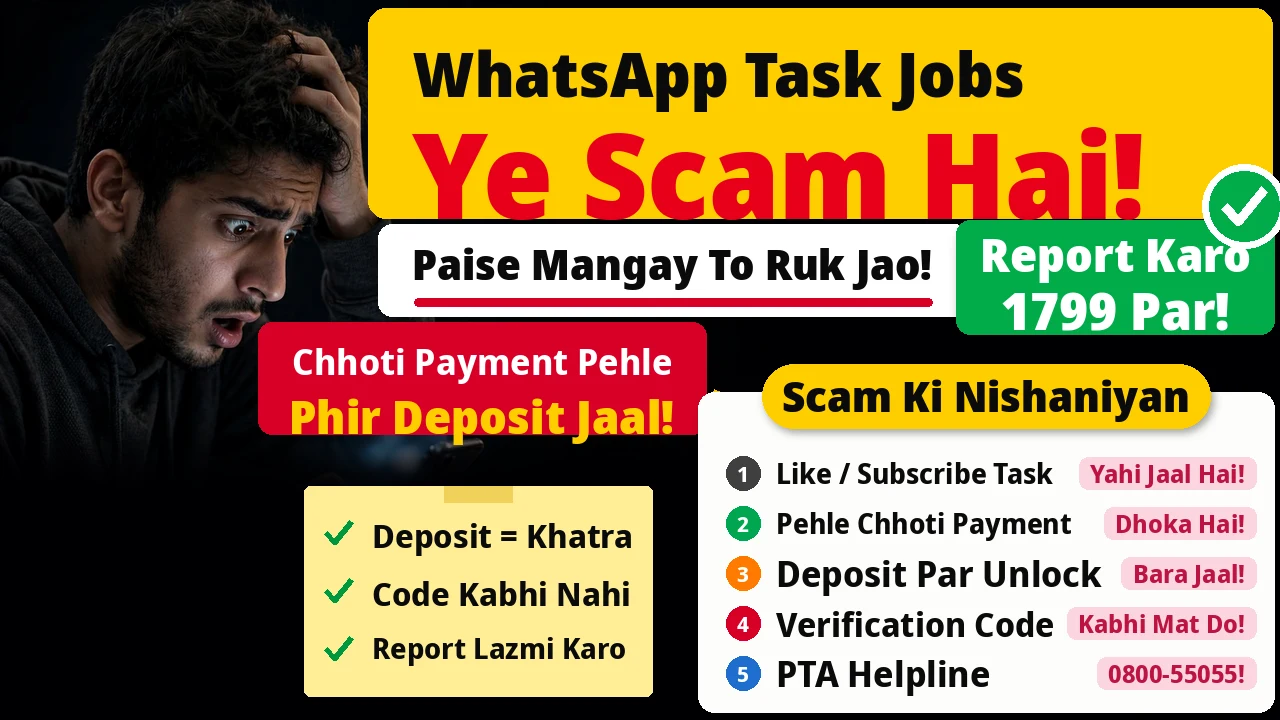
Scam 1: The Fake Freelancing Groups (the CERT “Honey-Trap” Warning)
In July 2025, Pakistan Today reported a National CERT advisory warning about fake freelancing scams targeting youth, students and freelancers — particularly in Punjab — through WhatsApp. The pattern is uglier than a simple fake job. Scammers pose as recruiters or agents of legitimate freelancing platforms, add victims to professional-looking WhatsApp groups (often padded with fake participants to look busy and real), and then explicit content appears in the group. Victims who react, forward it, or try to report it are then contacted by people impersonating law-enforcement officers, who threaten legal action or public exposure unless a large sum is paid. News coverage of the advisory reports extortion demands in the range of Rs 1 million to 1.5 million.
Read that figure carefully: it is the demand reported in the coverage, not a verified total of losses and not a victim count. This guide will not inflate it into either. What matters for you is the mechanism: the group is the bait, the explicit content is the leverage, and the fake officer is the collection department. No legitimate freelancing platform recruits this way, and no real officer collects fines over WhatsApp.
CERT’s reported advice is practical and worth following whether or not you have seen one of these groups: tighten your WhatsApp privacy settings (control who can see your profile photo and who can add you to groups), leave any group the moment explicit content appears, ignore unknown job offers that arrive out of nowhere, and use verified freelancing sites only. If you are already in such a group, do not argue with anyone in it and do not pay anything — screenshot everything first (more on evidence below), then leave, block and report.
Scam 2: The Task-Dashboard Deposit Trap (the One Most People Mean)
This is the scam most Pakistanis picture when they say “task scam,” and it runs like a script. A Pakistan-focused legal blog’s 2026 walkthrough of the pattern describes it step by step, and the steps match what victims across the country report:
- The invitation. An unsolicited WhatsApp, Telegram or Facebook message promises easy daily earnings for simple tasks, with “no investment needed.”
- The trust payment. Small tasks first — like a YouTube video, rate a product, click a link — and a small real-looking payment arrives, for example 300–600 PKR via EasyPaisa, JazzCash or bank transfer. This payment is the most expensive part of the scam for the scammer, and the most effective: it proves, falsely, that the system pays.
- The first fee. Then comes the turn: “submit just 300 PKR as a task fee” to unlock bigger tasks or to withdraw. The dashboard shows a growing balance — 500, then 1,500 PKR — that looks like progress.
- The escalation. Each payment unlocks a new requirement: 1,000, then 5,000, then 20,000 PKR, each framed as the last step before withdrawal. The balance on screen keeps growing. The money you can actually withdraw stays at zero.
- The disappearance. The scammer blocks you. The dashboard stops working. The group goes quiet.
The amounts above are pattern examples from the published walkthrough, not records of any one victim’s case — this guide invents no victim stories. But the mechanism is the whole story, and it generalises perfectly: a displayed balance is not money. A dashboard can show any number the scammer types. The only number that matters is money that has actually landed in your own bank or wallet, minus everything you sent in. And the “withdrawal frozen until you pay a fee” variant — sometimes dressed up as a tax, a verification fee, a negative-balance clearance or a VIP upgrade — is the same mechanism with different wording. A genuine employer or platform never asks you to send your own money to release money you have supposedly already earned. Legitimate platforms deduct fees from earnings; they never demand a deposit first.
That single test — never pay before you earn — catches nearly every version of this scam, including the “registration fee,” “security deposit” and “training kit” job ads that promise Rs 50,000–100,000 a month for simple work and then charge you to start. After payment comes nothing, a useless PDF, or a request to recruit others. The fee was the product all along.
Scam 3: The Verification-Code Hijack
The third trap does not even pretend to be a job. Scammers pose as delivery riders or as representatives of the Higher Education Commission (HEC), and ask you to share a verification code — framed as a delivery confirmation or an official check. The moment you share it, your WhatsApp account can be hijacked, and the hijacked account is then used to scam your contacts in your name.
The rule here is absolute and worth repeating to every family member who uses WhatsApp: never share a verification code with anyone, no matter how urgent or official they sound. Courier codes come only through official courier numbers, and no legitimate agency asks for your OTP, password, CNIC or ATM PIN by call or message. PTA has said exactly that in its public warnings: PTA will never ask for your personal details, passwords or OTPs. Anyone who does is, by definition, not who they claim to be.
How to Spot Any of Them in 30 Seconds
| Red flag | What it means |
|---|---|
| Job offer arrives unsolicited on WhatsApp/Telegram | Real platforms do not recruit by cold message |
| “No investment” — then a fee to start, level up or withdraw | The fee is the scam; the earnings are the bait |
| Dashboard balance grows but withdrawals need “one more payment” | The balance is typed, not real |
| Screenshots of other people’s earnings | Screenshots cost nothing to fake |
| Group full of strangers all “earning” and praising the admin | Often fake participants; social proof is manufactured |
| Someone asks for your OTP, code, CNIC or PIN | Account hijack in progress — share nothing |
| Threats from a “police officer” over WhatsApp | Impersonation and extortion, not law enforcement |
If two or more boxes tick, stop. Do not send money “just to test it,” do not share a code “just to check,” and do not stay in the group to see what happens. The test payment that “proves” a task app is real is the cheapest trick in the scammer’s kit — it costs them a few hundred rupees to win thousands from you.
What to Do If You Have Already Paid or Shared a Code
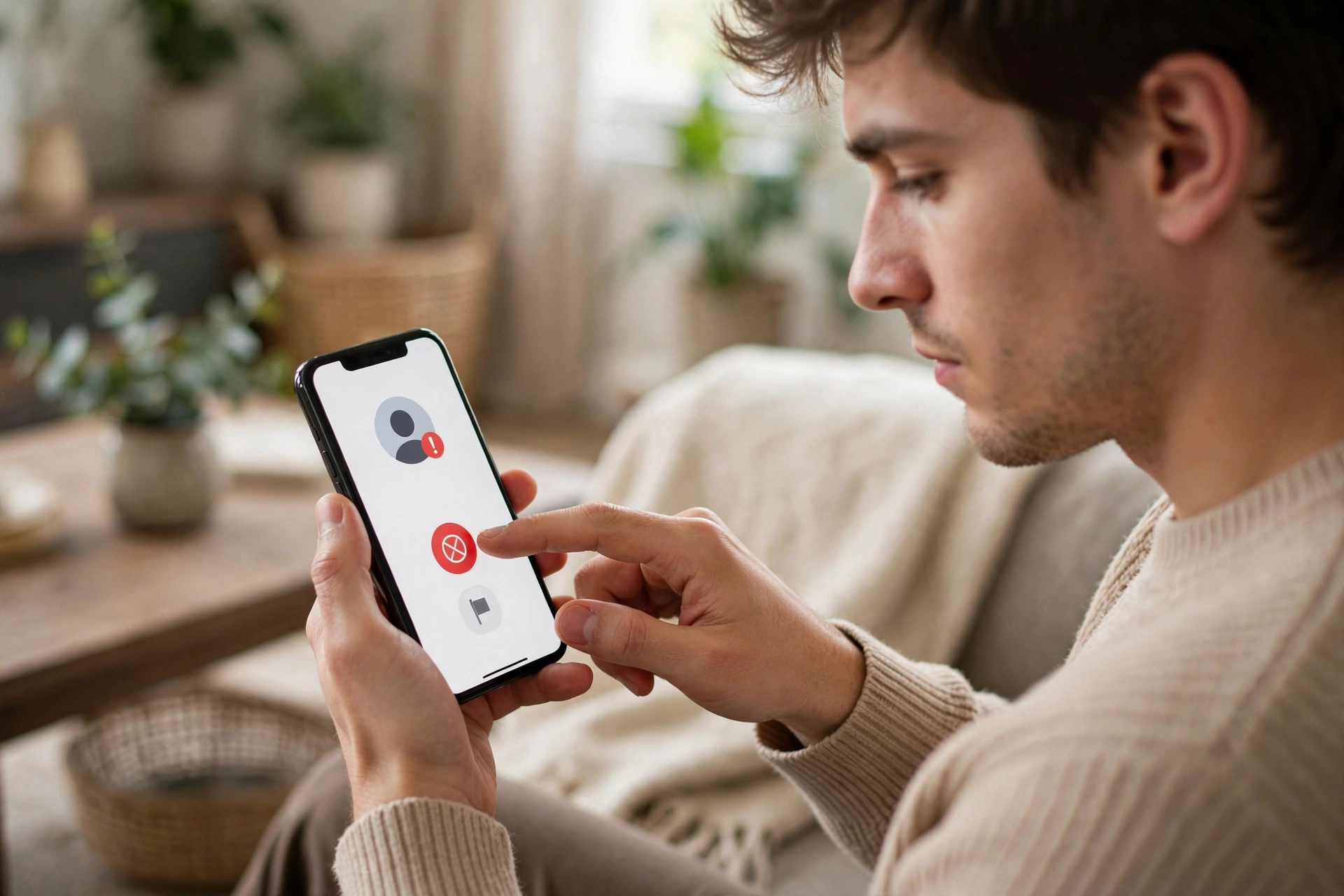
First, do not feel ashamed into silence — these schemes are built by professionals, and reporting quickly is what limits the damage and helps the next person. Second, act in this order:
- Stop all payments immediately. No “final fee” will release anything. Every further payment is a fresh loss.
- Preserve the evidence before you delete anything. Screenshot the full chats, the scammer’s number and profile, the group, the dashboard, and every transaction receipt. Note dates, amounts and wallet/bank details. Do not delete chats before capturing them.
- Contact your bank or wallet first if money moved. Call your bank’s fraud desk, or JazzCash/EasyPaisa support, immediately and ask about stopping or reversing the transfer. Speed matters more here than anywhere else.
- Report the number to PTA on 0800-55055 or at complaint.pta.gov.pk (or via the PTA CMS app), so the SIM behind the scam can be blocked.
- File a cybercrime complaint with NCCIA at complaint.nccia.gov.pk or on helpline 1799 (email: helpdesk@nccia.gov.pk), with your full name, CNIC, contact details, a description of what happened, the scammer’s number and IDs, amounts, and your screenshots. Keep the tracking/reference number you receive.
- In WhatsApp itself, block and report the number or group. Understand its limit: this acts on the WhatsApp account only, not on the SIM and not on the criminal case — so it is step six, not a substitute for steps four and five.
One outdated route to avoid copying from older guides: several older pages still present the FIA Cybercrime Wing (1991) as the primary complaint route. Cybercrime investigation has since moved to NCCIA, and current sources give NCCIA’s 1799 helpline and complaint.nccia.gov.pk portal. Likewise, an “NCCIA helpline 9911” appears in one low-authority blog and is not corroborated anywhere reliable — use 1799. If a guide’s reporting section is older than the agency change, its other advice may be stale too.
Real Alternatives That Never Ask You to Pay First
Walking away from a scam is easier when there is somewhere real to walk toward. Two routes from this site’s own guides pay through the same Payoneer account, charge nothing to join, and can explain exactly who pays you and why:
- uTest — test apps and websites and report bugs. Payments run twice a month (15th and last day) via Payoneer where available, and only approved work is paid. It is slow at first and your rating decides your invitations — the opposite of a dashboard that promises instant daily income. Full guide: uTest Pakistan.
- Fiverr — sell one real skill as a gig. Fiverr keeps a 20% commission, earnings clear after 14 days, and Pakistani sellers withdraw via Payoneer or bank transfer — never PayPal, which does not operate for receiving in Pakistan. Full guide: Fiverr Withdrawal Pakistan Without PayPal.
Notice what both have in common, and what no scam can copy: a named company, a real customer for the work, a published payment schedule, and a payout route you can verify in your own account. That is the standard to hold every “earning opportunity” to. If it cannot meet it, it does not deserve a rupee — or a verification code.
Frequently Asked Questions
Is every WhatsApp earning group a scam?
Not every group, but every unsolicited “task job” group that promises easy daily income should be treated as guilty until proven otherwise — and the proof is a verifiable company, a real website, and payment without any deposit. A group whose members’ earnings exist only as screenshots has proven nothing.
I received a small payment from a task app. Does that mean it is legit?
No. A small first payment is a standard part of the trap: it builds trust cheaply so that a much larger deposit follows. Judge the platform by whether withdrawals ever work without a new fee, not by whether the first tiny payment arrived.
Someone claiming to be police is threatening me over WhatsApp. What do I do?
Do not pay, do not argue, and do not share personal details. Screenshot everything, leave and block the contact, and report to NCCIA (1799 / complaint.nccia.gov.pk) and PTA (0800-55055). Real law enforcement does not collect fines or threats over WhatsApp.
I shared my WhatsApp verification code. What now?
Act fast: try to re-register your number on WhatsApp to reclaim the account, warn your contacts that messages from your account may be fraudulent, and report the incident to NCCIA and PTA with the scammer’s number. Never share a code again, even with someone claiming to help you recover the account.
Where do I report a WhatsApp task scam in Pakistan?
Three places, in order: your bank or wallet (if money moved), PTA on 0800-55055 or complaint.pta.gov.pk (to block the number), and NCCIA at complaint.nccia.gov.pk or helpline 1799 (the cybercrime complaint). Keep your screenshots, transaction receipts and the tracking/reference number.
If you remember one sentence from this guide, make it this one: real work pays you — scams ask you to pay first. The moment a “job” needs your money, your code, or your fear to function, it is not a job at all. Close the chat, keep the screenshots, report it, and build your income on the platforms that can show you, in your own account, that the money is real.
Related Tools & Guides
- CGPA to Percentage Converter — free tool for students applying to universities and jobs.
- Best Online Earning Platforms Without Investment (Pakistan Guide 2026) — the full platform comparison.
- uTest Pakistan: How to Earn as a Tester Without Investment — a real, no-deposit earning route.
- Fiverr Withdrawal Pakistan Without PayPal — get real freelance earnings out safely.





Leave a Reply