
If you earn online in Pakistan, sooner or later you ask one question: Payoneer fees Pakistan — what does Payoneer actually keep before your money reaches your bank? The honest answer is annoying: it depends on how the money arrived, how you withdraw it, and which of Payoneer’s own pages you believe. This guide lays out every layer, shows you where the guides contradict each other, and works through $100 and $1,000 examples so you can plan with real arithmetic instead of a guessed percentage.
Short version first: Payoneer is the rail that works in Pakistan — PayPal is not officially available here, and Payoneer is fully supported with withdrawals to Pakistani banks. But “Payoneer is free” is only true for opening the account. Receiving, withdrawing and converting all have costs, and the biggest cost is usually the cross-currency withdrawal fee, which Payoneer’s own fee table caps at 3%.
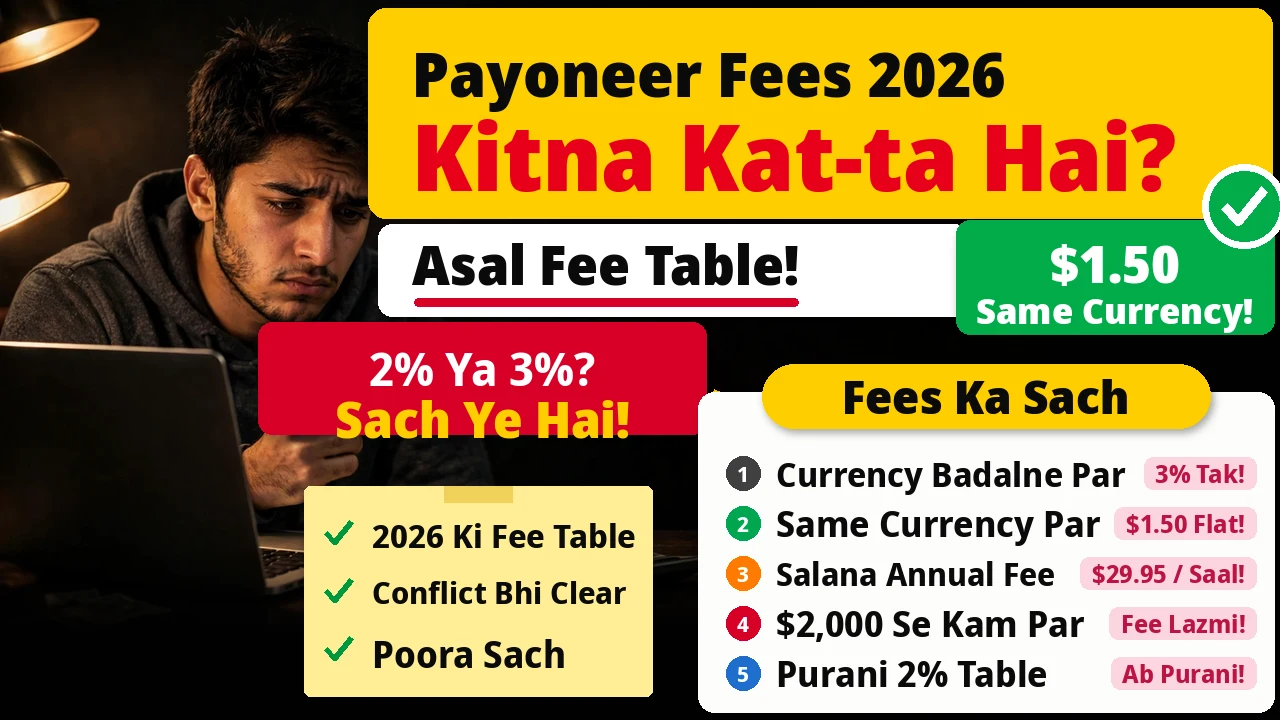
Payoneer Fees Pakistan: The Full Table, From Payoneer’s Own Pages
Start with the table, because most arguments about Payoneer fees come from people quoting different rows of it. Payoneer’s fee table, in its January 2026 costs blog, says:
| Step | Fee (Payoneer’s own table) | Note for Pakistan |
|---|---|---|
| Opening an account | Free | Free does not mean cost-free to use — see below |
| Receiving from customers | Up to 1% of the payment | Applies to direct client payments, not always to marketplaces |
| Receiving from partner platforms | Free (per Payoneer Pakistan guide) | Fiverr and similar partner payouts are the cheap route in |
| Receiving by card | Up to 3.99% + $0.49 | Avoid card payments from clients where you can — bank transfer is cheaper |
| Withdrawal, same currency | $1.50 flat (up to £50,000/month) | Only helps if you hold a USD bank account — most Pakistanis withdraw in PKR |
| Withdrawal, different currency | Up to 3% of the amount | This is the row that matters for a USD balance → PKR bank account |
| ATM withdrawal (card) | $3.15 per transaction | Plus any conversion fee — the most expensive way to get cash |
| Annual maintenance | $29.95 if under $2,000 received in 12 months | Disputed — see the conflicts section below |
Read that table as a ceiling, not a quote. “Up to 3%” means your actual fee can be lower — and Payoneer shows you the exact fee on your dashboard before you confirm a withdrawal. That dashboard quote is the only number that matters for your transaction. Everything in this article is planning arithmetic; your quote overrides it.
The Two Routes Out: Bank Transfer vs JazzCash
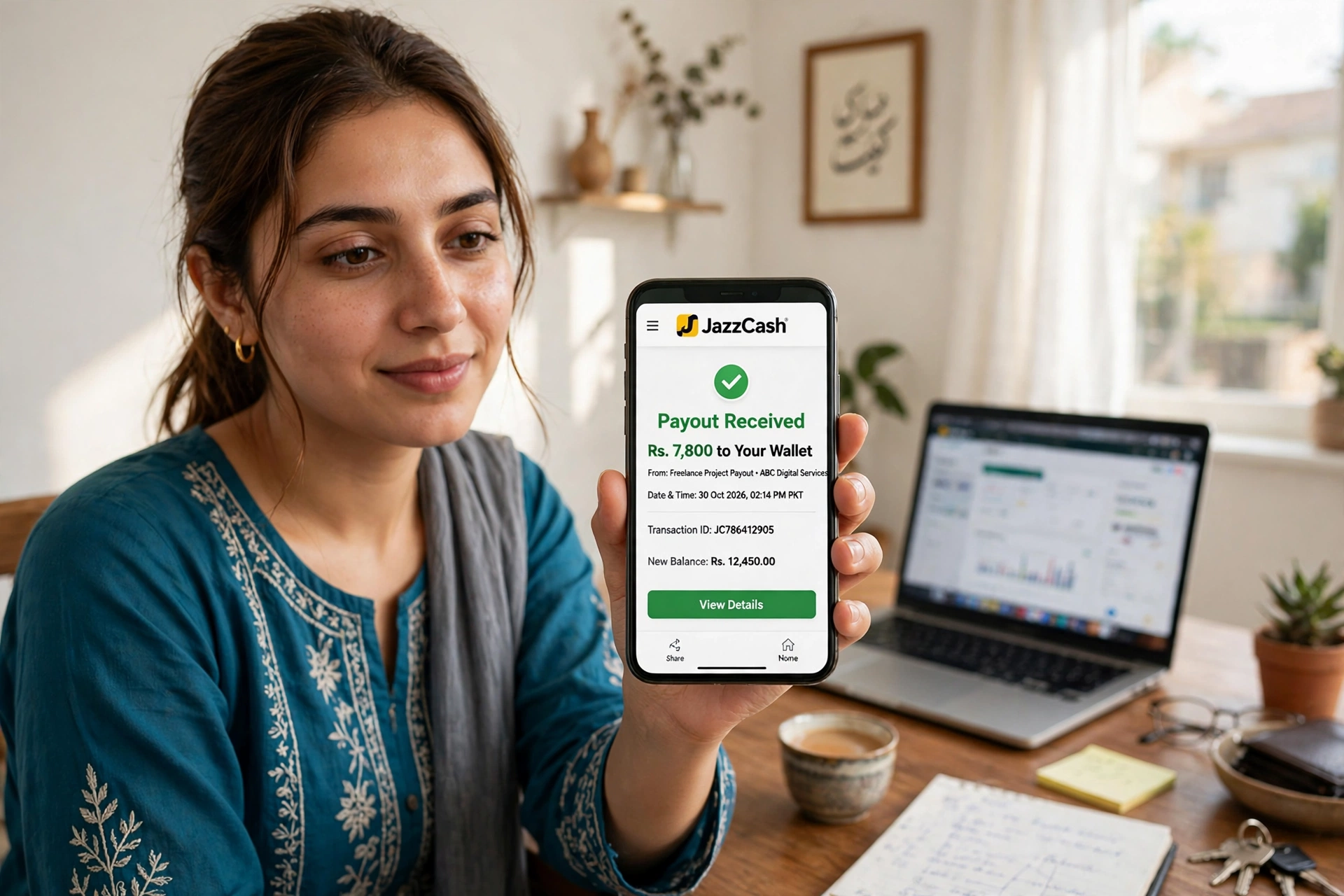
Most Pakistani freelancers use one of two exits. A bank transfer sends your balance to a Pakistani bank account — HBL, UBL, MCB, Bank Alfalah, Meezan and others are named in Payoneer’s Pakistan guide. The other exit is JazzCash: Payoneer’s JazzCash partnership material puts the in-app minimum at just $1, with real-time credit, which makes it the route for small balances that a bank minimum would trap. Our Fiverr withdrawal guide walks through both routes from the Fiverr side; the fee logic here is the same whichever platform earned the money.
The practical difference is thresholds, not just percentages. A bank withdrawal is reported with a $50 minimum per transaction in some 2026 guides, while the JazzCash route starts at $1. If your balance is $30, the bank route may not even be open to you yet — JazzCash is. Conversely, for large amounts the bank route is the natural home, and small frequent withdrawals can cost you more in total percentage terms than one larger withdrawal. Batch your withdrawals where you can; do not withdraw $20 five times if one $100 withdrawal does the same job.
Worked Examples: $100 and $1,000, With the Arithmetic Shown
Take $100 already sitting in your Payoneer balance, withdrawn to a PKR bank account at the full “up to 3%” cross-currency fee. The fee is $3, leaving $97 to be converted at Payoneer’s quoted rate that day. That is the whole fee story at this level — do not add a second, invented conversion percentage on top. One 2026 guide reports an additional ~2% conversion layer, but it appears in a single source, and Payoneer’s schedule already caps the withdrawal at 3%. Stacking the two would double-count the same cost.
Now take $1,000 from a direct client via a US receiving account. Receiving costs up to 1% ($10), and withdrawing cross-currency costs up to 3% ($30). Total Payoneer cost: about $40, or 4% — the same figure 2026 Pakistani reporting arrives at, and the reason older guides quoting roughly $31.50 for the same trip are now stale. They were built on the old 2% withdrawal rate. If the same $1,000 arrived from a partner marketplace where receiving is free, the receiving $10 drops away and you are back to roughly the $30 withdrawal fee alone. That single difference — marketplace vs direct client — is why two freelancers can quote different “Payoneer fees” and both be telling the truth about their own trip.
What about the PKR figure? Deliberately, this article quotes none. Payoneer’s conversion rate moves daily, sits below the interbank rate, and is shown to you before you confirm. Any article giving you a fixed PKR amount for $100 is either quoting a stale rate or inventing one. Use our site’s tools for fixed conversions, and for Payoneer, use the dashboard quote — or better, plan with percentages and let the quote fill in the rupees.
The Conflicts No Guide Resolves for You
Honesty requires naming the disagreements instead of picking the most convenient number. First, the withdrawal percentage: Payoneer’s Pakistan guide shows a 2% bank withdrawal figure, its January 2026 fee table says up to 3%, Mindrift’s help page says up to 2% onward to a bank, and 2026 Pakistani users report the full 3% being charged. The safe planning figure is 3%; the pleasant surprise, if any, is a lower dashboard quote. Second, the annual fee threshold: Payoneer’s own costs blog says $29.95 a year if you receive under $2,000 in 12 months, while 2026 guides report the threshold as $6,000. Until Payoneer clarifies, do not plan your year around either number — just know the $29.95 charge exists for low-volume accounts. Third, flat fees: Fiverr-side reporting varies between $1 and $3 depending on the exact route, which is why this guide keeps flat fees as “check your route” rather than a single figure.
There is also a cost that is not a Payoneer fee at all but still shrinks your payout: your bank’s own charges and any withholding tax on receipt. Those vary by bank, account type and filer status, and they sit outside Payoneer’s table. If your bank statement shows a deduction Payoneer did not quote, ask your bank first — it is usually theirs, not Payoneer’s.
How to Keep More of What You Earned
- Prefer marketplace payouts where receiving is free. Fiverr, Upwork and similar partner routes avoid the up-to-1% direct-client receiving fee.
- Ask clients to pay by bank transfer, not card. Card payments can cost up to 3.99% + $0.49 before you even withdraw.
- Batch withdrawals. One larger withdrawal beats several small ones, especially where flat fees or minimums apply.
- Use JazzCash for small balances, bank for large ones. The $1 JazzCash minimum exists precisely for the balances a bank minimum would strand.
- Never withdraw via ATM if a bank transfer is available. $3.15 a time, plus conversion, is the worst exit on the table.
- Always read the dashboard quote before confirming. It overrides every guide, including this one.
One route worth asking your bank about, not assuming: withdrawing in USD to a foreign-currency account, where the conversion happens at your bank’s treasury rate instead of Payoneer’s. Some Pakistani guides describe this for exporter/freelancer foreign-currency accounts. It can help or hurt depending on your bank’s rate that day, so compare it against Payoneer’s quote on the same day before choosing — never on the basis of a blog’s say-so.
Payoneer vs the Alternatives in Pakistan
It is fair to ask whether another rail would be cheaper, because Payoneer’s 4% all-in trip for a direct-client $1,000 is not small. Payoneer’s own Pakistan guide lists the alternatives honestly: Wise offers lower exchange-rate markups, but Wise is not directly available in Pakistan, which limits its usefulness for local withdrawals — a client abroad can send via Wise, but you cannot simply open a Wise account in Pakistan and withdraw the same way. Skrill is listed as available for freelancers and online transactions with bank withdrawals, and Western Union for receiving personal payments. Neither plugs into Fiverr and Upwork the way Payoneer does, which is why Payoneer remains the default even where it is not the cheapest on paper.
Newer fintech options appear in 2026 reporting — for example, a US-dollar account product pitched to Pakistani freelancers with a flat withdrawal fee — but their inbound routes, limits and long-term availability change fast, and this guide will not recommend one on the basis of a single blog post. The test for any alternative is the same three questions: does it accept payouts from the platform you actually earn on, can you withdraw it to a Pakistani bank or JazzCash in your own name, and what does its own fee page — not a review — say it charges? If any answer is unclear, Payoneer’s known, if imperfect, table beats an unknown promise.
There is one more comparison worth making, because it confuses a lot of beginners: Payoneer is not a bank account, and it is not a currency exchange shop. It is a payment rail. Comparing its 3% withdrawal fee to a bank’s foreign-exchange spread alone is comparing two different steps — the rail fee and the conversion are both real, and on a cross-currency withdrawal Payoneer’s quoted rate already reflects its conversion terms. That is why the dashboard quote, which combines fee and rate into one final figure, is the only comparison that counts. Two freelancers arguing about whether Payoneer “charges 2% or 3%” are usually arguing about different rows, different routes, or different years of the same table.
Before You Press Withdraw: A 60-Second Checklist
- Check the route. Bank or JazzCash? The minimum and the fee row are different for each.
- Read the dashboard quote. Fee plus rate, in PKR, before you confirm — screenshot it if the amount matters.
- Batch if you can. If a second payout is days away, waiting for one larger withdrawal usually beats two small ones.
- Confirm the receiving account is yours. Name mismatches are the most avoidable withdrawal failure there is.
- Note the date. If a fee looks different from last month, it may genuinely have changed — fee tables do move, as the 2%-to-3% shift shows.
Frequently Asked Questions
Is Payoneer free in Pakistan?
Opening an account is free, and receiving from partner platforms is free. Receiving from direct clients costs up to 1%, and withdrawing to a PKR bank account costs up to 3% cross-currency. Free signup is not the same as free use.
What is the Payoneer withdrawal fee in Pakistan in 2026?
Plan on up to 3% for a cross-currency withdrawal to a PKR bank account — that is Payoneer’s own fee-table ceiling, and 2026 Pakistani users report the full 3% being charged. Older guides quoting 2% are stale, and your dashboard quote is the final figure.
What is the minimum Payoneer withdrawal in Pakistan?
It depends on the route: the JazzCash in-app route is reported with a $1 minimum, while bank withdrawals are reported with a $50 minimum in some 2026 guides. Check the minimum shown in your own account for your chosen route.
Does Payoneer charge an annual fee?
Payoneer’s costs blog says $29.95 a year if you receive under $2,000 in 12 months; some 2026 guides report the threshold as $6,000. The charge itself is real for low-volume accounts; the exact threshold is currently disputed, so do not rely on either figure alone.
Can I avoid Payoneer fees by using PayPal instead?
No — PayPal is not officially available in Pakistan, so it is not a working alternative for receiving and withdrawing locally. Payoneer remains the practical rail, which is why understanding its fees matters more than wishing for another one.
Final honest note: Payoneer is not cheap, but it is predictable once you know which row of its table applies to you. Marketplace money in, one batched withdrawal out, dashboard quote checked before confirming — that discipline saves more than any “fee hack” ever will. For platform-specific routes, start with our main platforms guide and the Mindrift Pakistan guide, then come back here before you press withdraw.
Related Tools & Guides
- Fiverr Withdrawal Pakistan Without PayPal — the Fiverr-to-Payoneer-to-bank route, step by step.
- Mindrift Pakistan AI Trainer Guide — earn on Mindrift, then withdraw through Payoneer.
- Best Online Earning Platforms Without Investment (Pakistan Guide 2026) — the full platform comparison.
- CGPA to Percentage Converter — free tool for students applying to universities and jobs.





Leave a Reply