
If you have searched for CrowdGen Pakistan, you have probably found two kinds of pages and neither is quite what you need: global reviews that talk about Appen in general, and short local blog posts that repeat the official claims and stop there. The questions a Pakistani contributor actually needs answered are different. Can you join from Pakistan at all? Which projects will ever be open to you? How do you get paid here — and how long do you wait? This guide answers those questions from CrowdGen’s own help pages, with the gaps stated plainly instead of filled with guesswork.
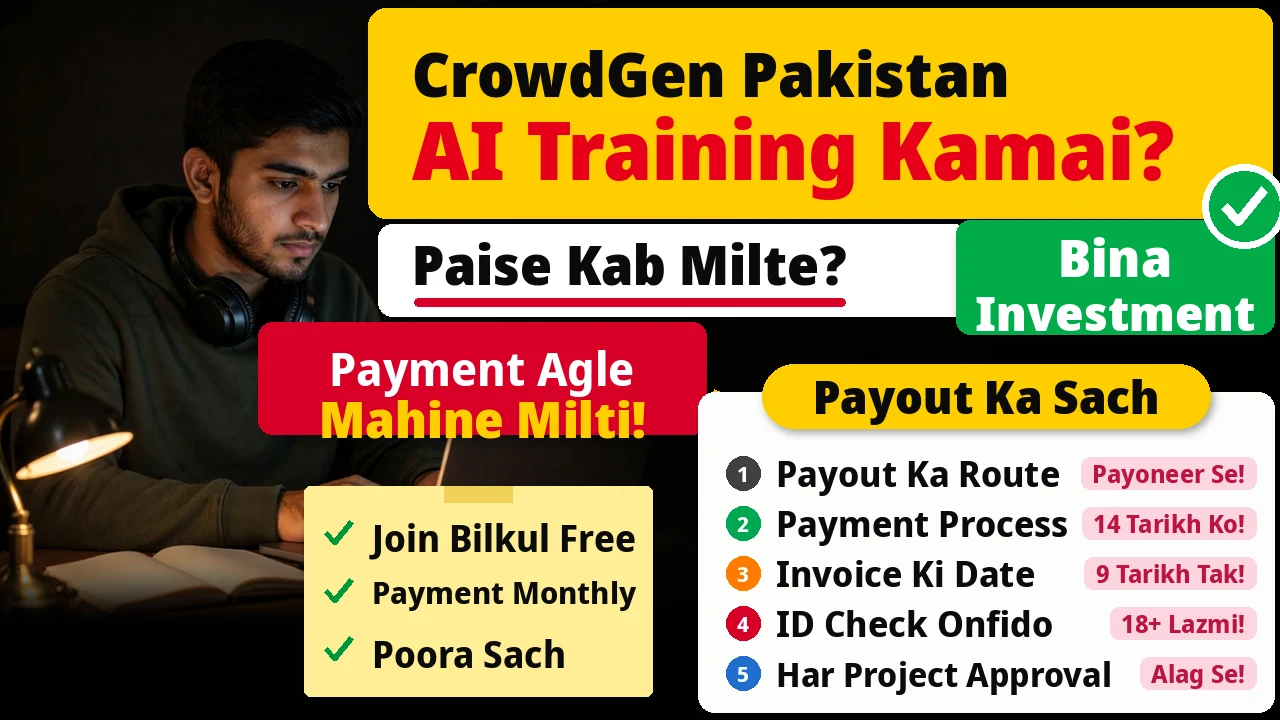
Short version first: CrowdGen is Appen’s contributor platform, joining is free, and it pays monthly through Payoneer — the route that works from Pakistan — after a monthly invoicing cycle. There is no fee to join, no training fee and no deposit. If anyone on WhatsApp or Telegram asks you to pay to activate a CrowdGen account, that person is not CrowdGen, however convincing the screenshots look. Our WhatsApp task-job scam guide explains exactly how that trick works.
What CrowdGen Actually Is
CrowdGen is where Appen — an AI data company founded in 1996 and listed on the Australian stock exchange — recruits and manages the people who train and test AI systems. Contributors evaluate AI answers, annotate and label data, transcribe and translate, check search and social-media results, and review content for accuracy and safety. It is judgement work, not clicking or watching videos: you read something, compare it against strict guidelines, and record a decision a machine cannot reliably make on its own.
The important structural fact is that CrowdGen is project-based, not task-queue work. You do not log in and pick jobs off an open board. You apply to a specific project, pass its qualification steps, and then work on the project you were matched to. That single difference explains most of the disappointment people report: creating an account is not the same as having work. Your profile — skills, languages, dialects, location, education — is what CrowdGen uses to match you, and a project can fill up while you are still qualifying, leaving you on a reserve list. CrowdGen’s own help page says qualifying does not guarantee immediate activation, and that it typically takes one to two weeks after qualifying to receive a project invite.
You work as an independent contractor, not an employee. There is no salary, no fixed shift and no promise of hours. Some projects set a weekly target — a reported Pakistan social-media project asked for 20 hours a week — while others are flexible. Always read the individual project page before you invest hours in its qualification: the rate, the hours and the location rule on that page are the only numbers that apply to you.
CrowdGen Pakistan: Can Pakistanis Join?
Here is the honest position, and it is the same kind of honesty we used in our Mindrift Pakistan guide. CrowdGen does not publish a list of eligible countries. Each project sets its own location requirements, and CrowdGen says you must work from the country — and in the US, the state — listed on your profile. You cannot work while travelling outside your country of residence; if you move, you update your profile address before working again.
What that means for Pakistan is neither a yes nor a no in general — it is a per-project answer. Pakistanis have seen Pakistan-specific projects: a Pakistan-based Urdu Social Media Evaluator project has been published, asking for native Urdu fluency, a bachelor’s degree or higher, a personal social-media profile and a laptop or desktop computer, with work involving fact-checking social-media content. An Urdu-to-English AI translation evaluator posting has also appeared, asking for native bilingual English and Urdu ability plus translation or translation-evaluation experience. Those examples prove Pakistanis are in the pool CrowdGen recruits from. They do not prove those projects are open today, and this guide will not pretend otherwise — project openings change, and a listing from last year is not a vacancy.
Your practical edge in Pakistan is language. English, Urdu and regional languages are genuinely useful here: evaluation, transcription, translation and social-media work all need native-level speakers, and Urdu is a language global platforms cannot staff from London or California. If you speak Urdu fluently and write clear English, say so precisely on your profile — including dialect where the form asks — because matching runs on those fields. If you have a degree, a linguistics background or translation experience, list it honestly; several Pakistan-facing projects ask for a degree, and inventing one will fail the ID and qualification checks anyway.
How to Apply Without Wasting Weeks
First, go to the official platform — crowdgen.com — and apply through a project opening, not through a link forwarded in a chat group. CrowdGen’s own warning is blunt: official emails come from its own domain, it never asks you to pay to apply or start, and it never asks for bank PINs or passwords. Treat any offer that arrives on WhatsApp or Telegram, or asks for a fee, as a scam until proven otherwise.
Second, build the profile properly before you chase projects. Languages (Urdu as primary where that is the project language, English alongside it), education, skills, devices and location must match reality, because qualification tests and ID checks are built to catch mismatches. Most projects require an identity check — government ID front and back plus a selfie, handled through Onfido — and you must be 18 or over.
Third, apply to projects that fit, and read their guidelines before the qualification test, not during it. CrowdGen provides study guides and practice material for many projects; use them. Qualification time is the hidden cost of this platform, and here the sources disagree in a way you should know about: CrowdGen’s expert-domain qualification is described as paid for your time, while its general project guidance says time spent on qualification tasks is not billable. Do not assume your qualification hours will be paid. Assume they are unpaid unless the specific project page says otherwise, and only invest them in a project you genuinely fit.

How CrowdGen Pays in Pakistan
CrowdGen pays monthly, not per task and not on demand. Its own payments FAQ gives the cycle: hours worked in a given month appear in invoices by the 9th of the following month and are processed for payment on the 14th. Independent reviews of the same FAQ put arrival between the 14th and 20th of the following month, depending on the payout method. Work in October, in other words, is invoiced in early November and paid mid-November. If you need money this week, CrowdGen is the wrong platform — that wait is built in, not a delay you can chase.
Payouts run through Dots, a payments provider, and the methods available depend on your country. The list CrowdGen names includes PayPal, local bank transfer, Airtm, SWIFT and Payoneer, plus gift cards in some places. For Pakistan, plan on Payoneer. PayPal is not officially available in Pakistan, so the PayPal route that works for a tutor in another country is not a route to plan around here. CrowdGen’s own Payoneer page tells existing Appen contributors they must set up their payment method again on CrowdGen — an old Appen Connect method does not carry over automatically — by going to Payments, then Withdrawal Methods, selecting Payoneer and entering their existing account details. Do that immediately, not when your first payout is due: CrowdGen blocks payment-method changes during the processing cycle, between the 6th and 15th of the month, so a last-minute fix can cost you a whole cycle.
Two cost warnings matter. First, CrowdGen itself does not charge a fee, but payout providers may deduct theirs — the example CrowdGen’s reviewers cite is PayPal outside the US taking 2%, capped at $20, and Payoneer’s own onward fees to a Pakistani bank are covered in our Payoneer fees Pakistan guide. Second, small balances may be held until they are larger than the payout fee. CrowdGen’s FAQ does not publish a single universal minimum, so do not budget around a fixed threshold you read on a blog; the reliable figure is the one shown in your own Payments section for your chosen method. Self-reported hours, where a project uses them, are due by the 2nd of the following month — miss that and your month slips.
| Item | What CrowdGen’s own pages say | What it means in Pakistan |
|---|---|---|
| Pay cycle | Invoiced by the 9th, processed on the 14th of the following month | October work is paid mid-November; plan cash flow around a month’s wait |
| Payout route | PayPal, Payoneer, bank transfer, Airtm, SWIFT via Dots | Choose Payoneer; PayPal is not officially available in Pakistan |
| Joining cost | None — never asked to pay to join | Any fee request is a scam, full stop |
| Age and ID | 18+, ID check on most projects | Government ID + selfie; use your own details throughout |
| Work location | Must match the country on your profile | Do not work while travelling abroad on a Pakistan-listed project |
| Rate | Stated on each project before you start | No universal rate exists; the project page is the only real number |
The Honest Catches: Rates, Availability and Reviews
Now the part the homepage does not emphasise. CrowdGen advertises expert rates up to $100 an hour overall, and up to $90 for healthcare administrators, $95 for linguists, $150 for software engineers and investment managers, $160 for accounting experts, $180 for FP&A analysts, $400 for legal experts and $450 for medical clinicians. Those are maximums for expert domains, by location and skill — not typical pay, and not what a general project in Pakistan pays. At the other end of the range, one reported Pakistan social-media evaluator project listed $2 an hour. Both numbers are real in the sense that both were published; neither is a promise about your project. The rate on your project page, read before you apply, is the only one that counts, and rates are set by location and project as much as by skill.
Availability is the second catch. Projects open and close, some weeks bring nothing that fits your profile, and acceptance for one project says nothing about the next. Recent independent reviews are blunt about this: work is not guaranteed, pay is set by country and language, and reviewers report logged hours disputed and accounts closed after failed ID checks. Review aggregations also show low average ratings for both Appen and CrowdGen on Trustpilot — around 1.5 out of 5 across hundreds of reviews — which is a warning to read, not a verdict to copy blindly: people who had a smooth payout rarely write reviews, and people whose hours were cut do. Treat it as evidence that friction is common, not proof that every contributor is unpaid.
Third, quality control is strict. This is the same pattern as Mindrift: work that fails review is not paid, and repeated failures can cost you the project. Read the guidelines twice, follow them literally rather than sensibly — in annotation work, the guideline beats your opinion — and keep your submitted hours accurate. Disputes go through the platform’s support ticket route, not through the person who recruited you, and there is no recruiter to appeal to in the first place.
Is CrowdGen Worth It From Pakistan?
Compare it honestly with the other AI-training option on this site. Mindrift, covered in our Mindrift guide, pays twice a month per accepted task with a $20 Payoneer minimum; CrowdGen pays once a month on a monthly invoice cycle. Mindrift suits someone who wants open tasks to pick up; CrowdGen suits someone with a specific language or domain strength who can wait for the right project and then commit to its hours. Neither replaces a salary, and neither pays quickly. If you need fast cash, neither is the answer — reselling or tutoring, covered elsewhere on this site, pays sooner. If you want skill-building work that can grow into specialist rates, CrowdGen is worth a profile and two or three well-chosen applications, with the expectation that the first month may bring nothing at all.
Start this week with three concrete steps. One: create your CrowdGen profile with honest languages, education and location, and set Payoneer as your withdrawal method on day one. Two: apply only to projects whose language and degree requirements you actually meet, and read the full guidelines before qualifying. Three: keep a simple log — project, rate, hours submitted, invoice date, payment date — so you can see your real rate per accepted hour after two months instead of believing any headline, including ours. If after two months you have no project, that is information too: your profile may need a stronger language or domain fit, not more applications to the same projects.
Frequently Asked Questions
Can Pakistanis join CrowdGen?
Yes, in the sense that CrowdGen recruits contributors in many countries and Pakistan-specific projects have been published — but eligibility is set per project, not by a published country list. Check the location requirement on each project page before qualifying.
How does CrowdGen pay in Pakistan?
Monthly, through its payments provider Dots. Hours worked in a month are invoiced by the 9th of the following month and processed on the 14th, usually arriving between the 14th and 20th. Choose Payoneer as your withdrawal method; PayPal is not officially available in Pakistan.
Is there a fee to join CrowdGen?
No. CrowdGen says it will never ask you to pay anything to join its projects. Any fee, deposit or “activation charge” — especially one requested on WhatsApp or Telegram — is a scam.
How much can I earn on CrowdGen in Pakistan?
There is no reliable single figure. Advertised expert maximums reach hundreds of dollars an hour, while a reported Pakistan social-media project listed $2 an hour. Your rate is the one printed on your project page, and it depends on the project, your location and your qualifications.
Do I need a degree to join CrowdGen?
Not for every project, but some Pakistan-facing projects do ask for a bachelor’s degree or higher, and most projects require an ID check. General projects may need only language fluency and a passed qualification; expert projects need domain expertise.
Why have I not received a project invite after qualifying?
CrowdGen says it typically takes one to two weeks after qualifying, and that a project reaching maximum capacity during your qualification puts you on a reserve list. Check your dashboard’s “In Qualification Process” tab, check spam for CrowdGen emails, and finish any incomplete qualification step before contacting support.





Leave a Reply