Online Earning Guides
Best Online Earning Platforms Without Investment (Pakistan Guide 2026)
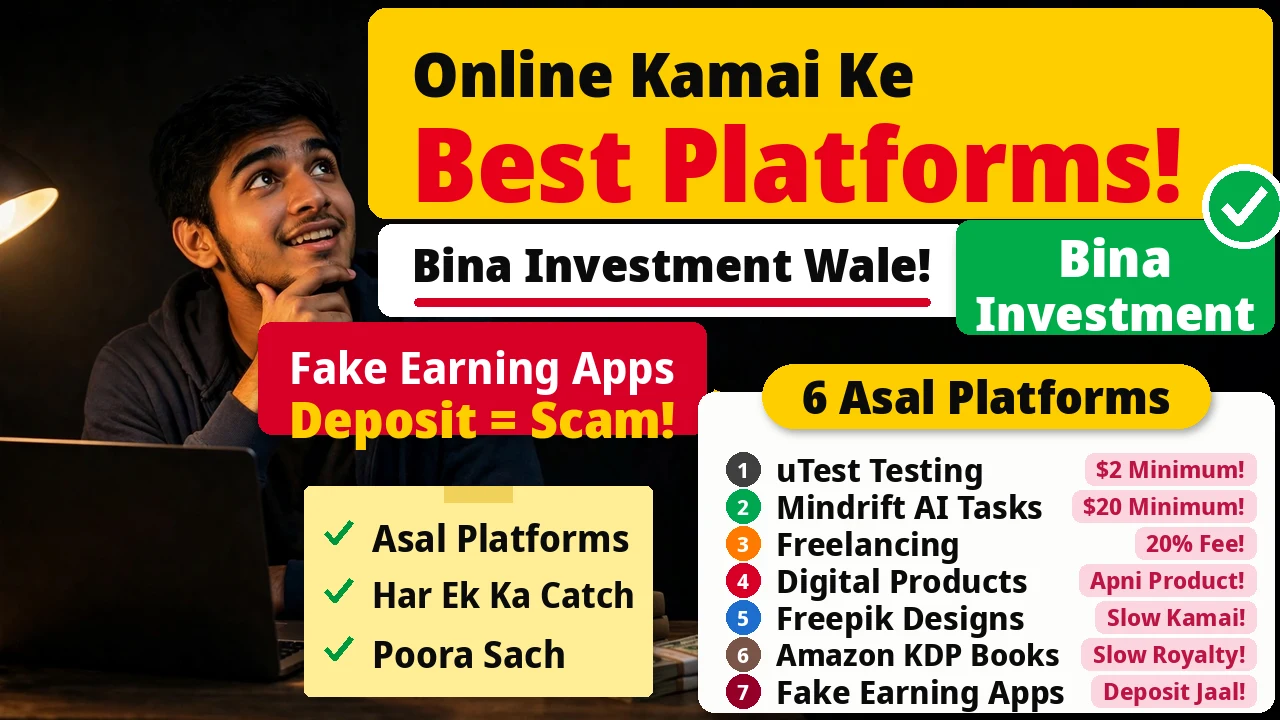
Type “online earning without investment” into Google and you’ll mostly get two kinds of pages: the honest ones, and the traps. The traps are easy to spot once you know the smell — fixed daily income, screenshots of someone’s JazzCash, “just watch videos and earn.” Here’s the less exciting truth, and honestly the more useful one: earning online with zero investment is real — but it starts slow, the first payment is usually small, and nobody legitimate pays you for doing nothing. If an app promises daily income before you’ve done any skilled work, it’s lying to you. This guide is about telling the difference — and the platforms actually worth your time.
Every platform on this list passed one simple test: a beginner in Pakistan can join for free, do real work, and actually get the money out through Payoneer or a local bank account. The ones that failed aren’t here — and the outright scams are exposed near the end, in the “avoid” section.

How We Judge a Platform
Our five checks — honestly, use these on any platform you ever come across:
- It pays real money for real work or real products — not points, not coins, not some “balance” that never turns into cash.
- It works from Pakistan. The country isn’t banned, and Pakistanis can genuinely use it end to end.
- Joining costs nothing. No deposit, no “activation fee”, no starter package you have to buy first.
- The payout route actually reaches Pakistan — Payoneer, or a local bank transfer you can withdraw from. (PayPal alone is a dead end here; it doesn’t offer accounts in Pakistan.)
- The minimum payout is reachable. If the threshold is so high a beginner never touches their money, that’s a red flag, not a feature.
Everything below passes all five. Every scam in the avoid section fails at least two.
1. uTest — Get Paid to Test Apps and Websites
uTest is run by a testing company called Applause, and the idea is simple: before an app or website launches, real people need to poke at it and report what breaks. That’s you. You don’t need a degree or QA experience — signing up is free, and the free uTest Academy teaches you how to write bug reports that get approved instead of rejected. Even your phone counts as a qualification, because test cycles get matched to the devices you own.
How the money works: you’re paid per approved bug — commonly around $5–$25, more if the bug is critical — and per completed test case. uTest pays twice a month, on the 15th and at month-end, via Payoneer, and the Payoneer minimum is just $2 per pay period. That tiny threshold matters: your first small payment actually reaches you instead of sitting trapped below a withdrawal limit.
Now the honest catch. Invitations depend on your tester rating, and everyone starts low. The early Academy training cycles are unpaid, too. So expect sporadic work at first — a decent early month might bring a few tens of dollars, and some weeks, nothing at all. Treat it as side income that grows with your rating, not a salary.
2. Mindrift (Toloka) — Train AI, Get Paid Per Task
Mindrift is Toloka’s platform, and the work is rating, correcting and writing AI responses — the human feedback AI systems get trained on. The simple “all-access” tasks are open to anyone; the better-paid specialised projects match your education and skills. Either way, every task shows its reward before you start — no guessing.
How the money works: Mindrift pays twice a month, on the 5th and the 20th, through Payoneer. (Tipalti/PayPal is the other option, but PayPal doesn’t work from Pakistan, so Payoneer it is.) Joining is always free — Mindrift never asks contributors to pay for training, equipment or deposits, so if someone asks, you’re talking to a scammer wearing its name. Pakistan isn’t on Mindrift’s published excluded-country list, though individual projects can set their own location rules.
The honest catch: those advertised hourly rates you see floating around? They describe the specialist tier. Open tasks pay a small fixed reward each — often well under a dollar — and availability comes and goes. The specialised projects also add CV, assessment and ID verification, so without a government ID you’re limited to the lower-paid open tasks. And one rule people miss: the work has to be your own — these platforms ban AI-generated answers, so a chatbot can’t do this job for you.
3. Freelancing — Sell a Skill, Keep Most of What You Earn
Freelancing is the highest-earning route on this list — and the slowest to start, I won’t pretend otherwise. A client pays you for a skill: writing, design, video editing, data entry, programming. Find clients directly (social media, communities, outreach; payment by Payoneer), or use marketplaces that find them for you and take a cut.
Fiverr
Fiverr works from Pakistan, and it charges 20% of every order — you keep 80%. Withdrawing runs through Payoneer: roughly a $10 minimum to your Payoneer balance, or $20 for a bank transfer routed through Payoneer. Set the payout method up early — Fiverr applies a waiting period after you add or change it, and new sellers wait for earnings to clear before withdrawing. But here’s what nobody warns you about: the fee isn’t the hard part. Winning your first orders in a crowded market is. One narrow, specific gig beats ten generic ones, every time.
Upwork — powerful, but read this first
Upwork has the bigger clients, and it pays Pakistanis conveniently — Direct to Local Bank costs $0.99 per withdrawal with a $5 minimum, and Payoneer works too. Its freelancer fee is now variable, between 0% and 15% per contract, and you see the exact percentage before accepting anything. But there’s a hard gate to know about first: Upwork requires identity verification with a government-issued ID. Without it, you can’t properly submit proposals or withdraw earnings. Got a CNIC or passport? Then yes, Upwork is a serious option. If not, build on Fiverr, direct clients, or the other platforms here instead — no shame in it.
4. Lemon Squeezy and Paddle — Sell Your Own Digital Product
Everything above pays you for your time. This route is different — it pays you for a thing. A small digital product you make once and sell many times over: a template pack, a niche calculator, a guide, a design bundle. Lemon Squeezy and Paddle act as the “merchant of record”: they take the customer’s card payment, handle the global sales tax headache, then pay you.
How the money works: Lemon Squeezy pays out to Pakistani bank accounts (minimum $50); Paddle pays via Payoneer or bank wire (minimum $100). Both charge around 5% plus a small fixed fee per sale, and you don’t need a registered company to start. Our own free tools are exactly the kind of thing that can grow into a small paid product later. Two honest warnings, though. First, these platforms run identity checks that can ask for documents — test your account with a tiny real sale before building a whole business on it. Second, a product nobody knows about earns exactly zero — selling is a distribution problem, not a building problem.
5. Freepik Contributor — Sell Design Assets Slowly
If you can make vectors, illustrations or templates, Freepik’s contributor programme (now called Magnific Contributor) pays you a share of subscriber revenue per download. Uploading is free, and contributors get paid via Payoneer once they reach a $25 threshold.
The honest catch: the per-download amount is tiny — a few US cents — because your share gets divided across everything a subscriber downloads, and subscribers download a lot. You’ll need hundreds of downloads before the first payout, which means months of steady uploading in niches people actually search for. File this under “set it up once and let it trickle in the background” — background income, never the main plan.
6. Amazon KDP — Publish Books for Free, Earn Royalties Slowly
Kindle Direct Publishing lets anyone publish an ebook or paperback on Amazon for free — no printing costs, no stock gathering dust. You earn a royalty (35% or 70% on ebooks, depending on the option and price) on every sale, and royalties land about 60 days after the end of the sale month, into a bank account. A Payoneer receiving account works for many sellers.
The honest catch: there are two. First, the competition is brutal, and most authors earn very little with one or two titles — KDP rewards catalogues built over months and years. Second, since 2024 Amazon has been rolling out identity verification for KDP accounts, which can require a government-issued ID. If that request lands on your account and you can’t complete it, publishing and royalty release can stall. Go in with your eyes open — and never pay someone who offers to “publish your book for a fee” outside Amazon’s own free system. That fee is their whole business model.
Side-by-Side: The Honest Comparison
| Platform | What you do | Payout method | Minimum payout | Works from Pakistan? | Realistic expectation |
|---|---|---|---|---|---|
| uTest | Test apps/websites, report bugs | Payoneer | $2 per pay period | Yes | Small, irregular side income; grows with your rating |
| Mindrift | Rate and write AI training tasks | Payoneer | No fixed minimum published; balances paid on the 5th & 20th | Yes (project rules vary) | A few dollars to a few hundred in a good month; dry spells happen |
| Fiverr | Sell a service (a “gig”) | Payoneer / bank via Payoneer | $10 (Payoneer) / $20 (bank transfer) | Yes | Nothing until your first orders; then it can become real income |
| Upwork | Bid on client projects | Local bank / Payoneer | $5 (local bank) | Yes — government ID verification required | Highest ceiling here, but closed to you without an ID |
| Lemon Squeezy / Paddle | Sell your own digital product | Bank (LS) / Payoneer or wire (Paddle) | $50 / $100 | Yes | $0 until you have a product and buyers; then it scales |
| Freepik Contributor | Upload design assets | Payoneer | $25 | Yes | Cents per download; months to the first payout |
| Amazon KDP | Publish books | Bank / Payoneer receiving account | Royalties paid ~60 days after the sale month | Yes — ID check possible | Very slow; most authors earn little without a catalogue |

Platforms and Apps to AVOID
⚠ The one rule that protects you: real work pays you — scams ask you to pay first.
The moment any “earning” platform asks for money before you can earn or withdraw, close it. That single test catches almost every scam below.
- Deposit / top-up “task” apps. These show you a growing balance for liking videos or rating products, then demand a deposit to “unlock” bigger tasks — or to release your own withdrawal. The balance is fake; the deposit is the actual product; and one day the app disappears with it. I see this pattern constantly on Telegram and WhatsApp: a “recruiter” messages you first, sends screenshots of other people’s earnings, and before you know it you’re topping up. That friendly setup is the trap.
- Watch-ads and spin-the-wheel apps. You watch ads for weeks and your balance climbs — then withdrawal needs a minimum so high it never arrives, or a “processing fee” right at the end. The ads were real. Only your payout was imaginary.
- “Registration fee” courses and groups. Anyone selling access to earning secrets, signals or a “VIP earning group” earns from your fee, not from the method. Every legitimate platform in this guide is free to join — hold everyone else to that standard.
- Crypto doubling and referral “investment” schemes. If the returns depend on recruiting people whose deposits pay the earlier members, it’s a Ponzi pattern, however professional the dashboard looks. When recruitment slows, it collapses — and the last people in lose everything.
See the difference? uTest, Mindrift and Fiverr can explain exactly who pays you and why — a company needs testing, a client needs work. A scam can only show you other users’ balances. If you can’t answer “who is paying me, and for what?”, don’t deposit a single rupee.
How to Start in the Next 7 Days
- Day 1 — Set up Payoneer. Almost every honest route here pays through it. Create the free account, complete your profile, link your local bank account — before you earn anything, not in a panic afterwards.
- Day 2 — Join uTest. Fill in your profile properly — every device you own — and start the free Academy lessons. Profile completeness decides which invitations you get.
- Day 3 — Apply to Mindrift. Register, take whatever all-access tasks are open, and apply to specialised projects only if you can complete their checks. Check back regularly — projects open and close often.
- Day 4 — Pick ONE skill for freelancing. Not five. One — something you can already do, or can practise daily: document formatting, subtitle writing, thumbnail design, data entry, translation. Then look at what buyers on Fiverr are actually ordering in that category.
- Day 5 — Build your first offer. One narrow Fiverr gig (or a simple rate card for direct clients) with a clear deliverable and an honest beginner price. Have a government ID? Set up Upwork too. Don’t have one? Skip it without regret.
- Day 6 — Do your first real work sample. A practice bug report, a sample design, one short portfolio piece. Students, keep your documents ready too — our free CGPA to Percentage Converter turns your CGPA into the percentage universities and employers ask for, using your own university’s formula.
- Day 7 — Review, and commit. Write down what you applied to, what replied, and what you’ll repeat next week. The people who end up earning from these platforms aren’t the most talented ones — they’re the ones still applying in week eight.
Frequently Asked Questions
Can I really earn online in Pakistan without any investment?
Yes, genuinely. Every platform here is free to join, and uTest, Mindrift and Fiverr really do pay Pakistanis via Payoneer or local bank. But be clear about what “without investment” means: you invest time and skill instead of money, and the first payments will be small. That’s normal — small and real beats big and imaginary.
Which platform pays the fastest first payment?
Usually uTest or Mindrift — their minimums are tiny or non-existent and both pay twice a month, so your first approved work can turn into a real (small) payout within a few weeks. Freelancing can pay more per job, but winning the first order takes longer — and selling a product pays nothing until somebody buys.
I don’t have a CNIC or passport. Which platforms can I still use?
More than you’d think. uTest, Mindrift’s open tasks, Fiverr and Freepik Contributor don’t put a government-ID gate in front of earning — though you’ll still need a Payoneer account, which runs its own verification. Upwork requires ID verification, Mindrift’s specialised projects add an ID check, and KDP may request one, so plan around those honestly. And don’t borrow someone else’s documents to get past a check — that’s how accounts get banned.
An app says I must deposit money before I can withdraw my earnings. Is it legit?
No. Not once, not ever, not “just this one time.” Legitimate platforms deduct fees from money you’ve already earned; they never ask you to send money in. A deposit-to-withdraw demand is the most reliable sign of the task-app scams above. Walk away — and warn whoever sent you the link.
One last thing, because honesty over hype is the whole promise of this site: nothing in this guide is guaranteed income. What you earn depends on your skill, your effort, market demand, and each platform’s eligibility rules — which change, so re-check them when you join. What I can stand behind is the filter: every platform above pays real money for real work, charges nothing to join, and can actually pay you in Pakistan. Pick one, give it an honest month, and let your first payout be the proof — not a screenshot from someone else’s phone.